





Table of Contents
Introduction: Recruitment Has Shifted Permanently
Recruitment in 2026 is no longer a transactional hiring process. It is a continuous, data-driven system focused on attracting, engaging, and retaining talent. Organizations competing for skilled professionals must integrate employer branding, onboarding, and talent acquisition into a single, optimized pipeline. Fragmented hiring processes produce inconsistent results; integrated systems produce predictable outcomes.
What Are Recruitment Strategies?
Recruitment strategies are structured frameworks used to identify, attract, evaluate, and hire candidates aligned with business objectives.
Core components:
- Talent sourcing channels
- Candidate screening and selection processes
- Employer positioning
- Hiring metrics and analytics
Distinction:
- Recruitment = short-term hiring execution
- Talent Acquisition = long-term workforce planning and pipeline development
Key Recruitment Trends in 2026
1. Data-Driven Hiring
Decisions are based on measurable indicators such as:
- Time-to-hire
- Cost-per-hire
- Quality-of-hire
2. AI and Automation
Automation handles repetitive tasks:
- Resume screening
- Interview scheduling
- Candidate communication
3. Candidate Experience as Leverage
Poor experience reduces acceptance rates. High-performing organizations optimize:
- Application simplicity
- Communication speed
- Feedback transparency
4. Remote and Hybrid Hiring Models
Geographic barriers are removed. Talent pools are global, increasing competition and requiring stronger differentiation.
Employer Branding: The Attraction Engine
Definition
Employer branding is the perception of your organization as a workplace.
Strategic Impact
Strong employer branding:
- Reduces hiring costs
- Increases applicant quality
- Improves offer acceptance rates
Building a Strong Employer Value Proposition (EVP)
A defined EVP answers: why should a candidate work here instead of elsewhere?
Core EVP elements:
- Compensation and benefits
- Career growth opportunities
- Work culture and leadership
- Stability and reputation
Visibility Channels
- Career page optimization
- Social media presence
- Employee testimonials
- Job platform positioning
Metrics to Track
- Application conversion rate
- Offer acceptance rate
- Employer brand search volume
Onboarding Programs: Converting Hires into Output
Function
Onboarding transitions candidates into productive employees.
Phases
- Pre-Onboarding: documentation, communication, expectation setting
- Onboarding: orientation, role clarity, system access
- Post-Onboarding: performance alignment and feedback loops
Key Elements of Effective Onboarding
- Structured training timelines
- Role-specific onboarding plans
- Assigned mentors or supervisors
- Performance benchmarks within 30–90 days
Digital Enablement
Automated onboarding systems improve:
- Documentation processing
- Training delivery
- Progress tracking
Metrics
- Employee retention rate
- Time-to-productivity
- Early-stage performance scores
Recruitment Marketing: Building a Candidate Funnel
Definition
Recruitment marketing applies marketing principles to talent acquisition.
Funnel Structure
- Awareness
- Interest
- Application
- Selection
Content Strategy
- Job-focused blog content
- Industry insights
- Employee success stories
- Behind-the-scenes workplace content
SEO Optimization
- Keyword-targeted job descriptions
- Optimized career pages
- Structured data for job listings
Campaign Types
- Organic (SEO, social content)
- Paid (ads, sponsored listings)
Talent Acquisition: Long-Term Workforce Strategy
Definition
Talent acquisition is a proactive approach to securing talent aligned with future business needs.
Core Functions
- Workforce planning
- Talent pipeline development
- Succession planning
Candidate Relationship Management (CRM)
Maintains engagement with potential candidates before roles become available.
Diversity and Inclusion
Expands talent pool and improves organizational performance through varied perspectives.
Strategic Alignment
Hiring decisions are directly tied to:
- Business growth objectives
- Market expansion plans
- Skill gap analysis
Integration: Building a Unified Recruitment System
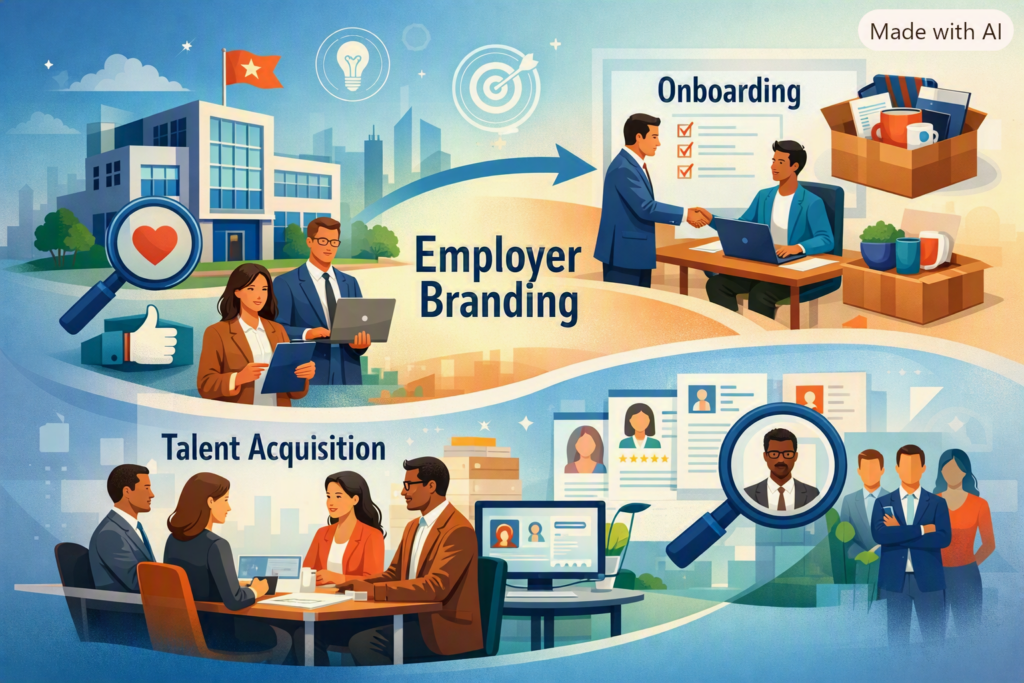
Effective recruitment in 2026 requires alignment across all components:
- Employer branding attracts candidates
- Recruitment marketing engages them
- Talent acquisition qualifies and pipelines them
- Onboarding converts them into productive assets
System outcome:
Reduced hiring friction, improved quality-of-hire, and higher retention rates.
Common Recruitment Failures
- Weak employer positioning
- Inconsistent candidate communication
- Lack of measurable hiring metrics
- Unstructured onboarding processes
Each failure point increases cost and reduces hiring efficiency.
Technology Stack for Modern Recruitment
- Applicant Tracking Systems (ATS)
- HR Management Systems (HRMS)
- Recruitment marketing platforms
- Data analytics dashboards
Technology centralizes data and standardizes processes.
Implementation Framework
- Define hiring goals aligned with business objectives
- Build and document recruitment processes
- Develop a clear employer brand and EVP
- Implement recruitment marketing campaigns
- Structure onboarding programs
- Track KPIs and optimize continuously
Key KPIs:
- Time-to-hire
- Cost-per-hire
- Offer acceptance rate
- Employee retention rate
Conclusion
Recruitment strategies that work in 2026 are integrated, data-driven, and candidate-centric. Organizations that align employer branding, onboarding, and talent acquisition into a single system achieve consistent hiring outcomes, reduced costs, and long-term workforce stability